A 15-yard roll-off container measures 16 feet long, 7.5 feet wide, and 4.5 feet high, designed specifically for footprint-restricted jobsites where a 20-yard roll-off would encroach onto street easements or block…
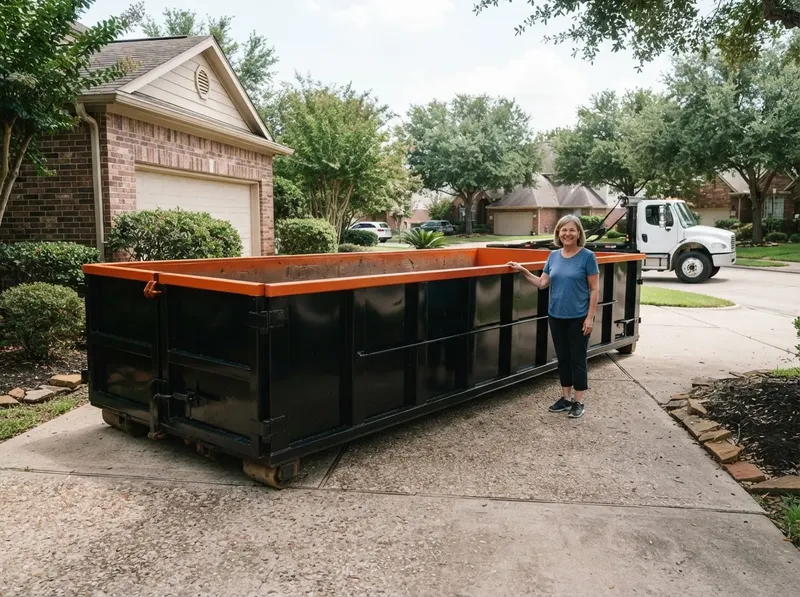
A 15-yard roll-off container measures 16 feet long, 7.5 feet wide, and 4.5 feet high, designed specifically for footprint-restricted jobsites where a 20-yard roll-off would encroach onto street easements or block access. In historic central neighborhoods like The Heights, Montrose, and West University Place, narrow driveways and tight radius turns demand disciplined drop-offs. The 4.5-foot sidewalls permit straightforward manual loading over the side while the rear swinging door opens flat to wheelbarrow heavy debris like ceramic tile or subflooring directly into the bed. Site logistics matter: drivers position protective blocking boards beneath steel rollers to prevent asphalt indentation or cracked pavers along residential properties in River Oaks and Memorial. Roll-off equipment conforms to standard axle load ratings tracked by the Texas Department of Transportation to prevent structural surface failure.
Selecting capacity requires mapping debris mass against physical container space. A 10-yard dumpster costs $595 and handles tight, high-density loads like pure dirt or masonry, but often overflows on multi-room drywall projects. A 15-yard dumpster at $650 provides the strategic balance for two-room gut cleanouts, medium kitchen renovations, or complete flooring removals without moving into the larger $695 20-yard price tier. Larger undertakings, such as structural framing cleanups in Oak Forest, whole-home estate liquidations in Garden Oaks, or hurricane repair projects in Meyerland and Clear Lake, demand 30-yard ($795) or 40-yard ($895) units. The primary trade-off with a 15-yard dumpster is volume ceiling versus clearance: it reserves critical driveway access for contractor vehicles while holding up to 4.5 tons of standard renovation refuse before breaching legal road limits verified by the Federal Motor Carrier Safety Administration.
Container placement requires 60 feet of direct linear pull-in clearance and 14 feet of vertical clearance away from low-hanging live oak limbs and power drops common to the East End (Second Ward). If street staging is mandatory, placement must observe the right-of-way codes enforced by the City of Houston Public Works. Hazardous materials, vehicle fluids, and uncertified refrigerants are strictly excluded per the Texas Commission on Environmental Quality and federal containment rules monitored by the Environmental Protection Agency. When sorting jobsite materials, items containing heavy metals fall under disposal guidelines maintained by Earth911, and job safety staging should align with site standards outlined by the Occupational Safety and Health Administration. Structural building debris disposal complies with criteria governed by the ASTM International waste standards, operations vetted by the National Waste & Recycling Association, and site planning models published by the National Association of Home Builders.
Every job gets a firm, written price after a free on-site visit.
For standards, safe disposal, and service guidance on DUMPSTER in Houston, TX, useful references include U.S. EPA, EPA, EPA, OSHA, Earth911, and Google Maps. General consumer and small-business resources are available from USA.gov, Better Business Bureau, FTC Consumer Advice, U.S. Small Business Administration, and Ready.gov.
Tell us about your 15-yard dumpster job in Houston and we'll send a clear, written quote, usually the same day.
 SummitHaul Container Co.